As parents, we often think that providing a rich environment for our children means filling our homes with the latest flashing, noisy toys. But if you have ever noticed your child ignore an expensive toy to play with a cardboard box, a set of keys, or a kitchen whisk, you already know a profound secret: children don’t want to be passively entertained. They want to explore, discover, and master real life.
One of the greatest benefits of the Montessori method is that it doesn’t have to stop when the school bell rings. By bringing the principles of a prepared environment into your house, you can create a Montessori home that nurtures your child’s natural independence, concentration, and sense of calm.
The best part? You don’t need a huge budget or a dedicated playroom. The core of a Montessori home is actually a beautifully minimalist environment. Here is a practical guide to transforming your living spaces into a haven for independent learning.
1. Shift Your Perspective (Get Down on Their Level)
The easiest way to start designing your home is to physically get down on your hands and knees and look at the room from your child’s height.
- Can they reach the door handles or light switches?
- Are all the toys hidden away in deep, heavy toy boxes where they can’t see them?
- Can they look out the window, or see the artwork hanging on the walls?
When our homes are built exclusively for adults, children have to rely on us for absolutely everything. By making small physical adjustments, like hanging art at their eye level or placing a small stool by the bathroom sink, you instantly give them the power to navigate their day autonomously.
2. Ditch the Toy Box for Low, Open Montessori Shelves
Deep toy boxes are where toys go to die. Children can’t see what’s at the bottom, so they end up dumping the entire box onto the floor, creating a chaotic environment that actively breaks down their focus.
Instead, invest in low, open Montessori shelves.
- Display, Don’t Store: Arrange just 6 to 8 high-quality activities or toys neatly on the shelves.
- Isolate the Activity: Use small trays or baskets to hold all the pieces for a single task (e.g., a basket with a wooden puzzle, a tray with paper and a few crayons).
- Toy Rotation: Put the rest of your toy stash in a closet out of sight. Every week or two, rotate the activities on the open shelf. When children aren’t overwhelmed by choice, they play more deeply, stay focused longer, and learn to take pride in returning a single tray back to its specific spot.
3. Embrace a Minimalist, Functional Aesthetic
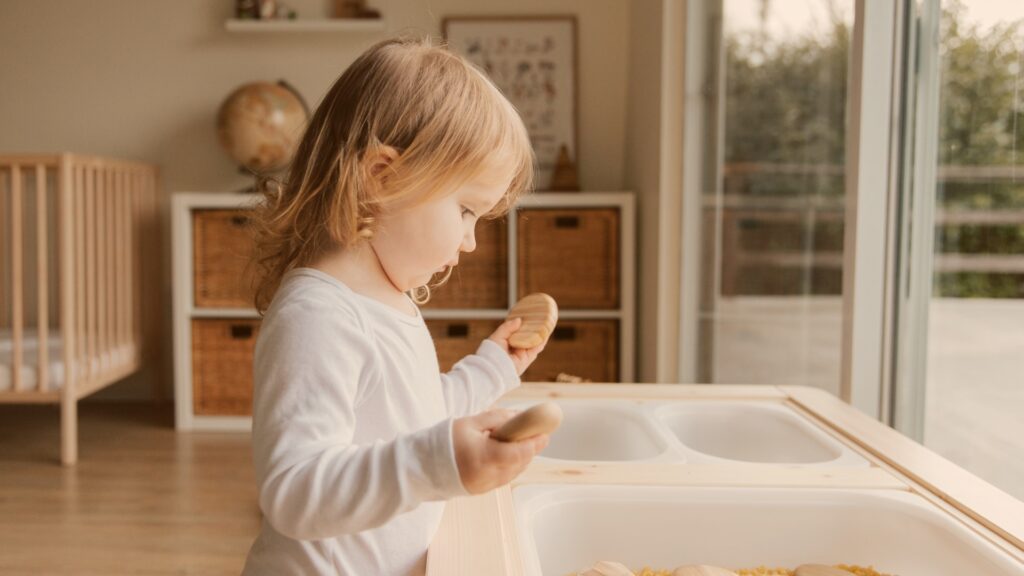
A true Montessori environment avoids overstimulation. Dr. Montessori advocated for natural lighting, neutral colors, and real materials like wood, glass, metal, and cotton rather than bright, cheap plastics.
When choosing items for your child’s space, opt for functionality over clutter. For instance, rather than a crib they cannot exit without you, consider a low floor bed that grants an older infant or toddler the freedom to wake up and quietly look at a book on their rug. Replace plastic toys that do the “work” for the child (by lighting up or making sounds at the push of a button) with open-ended materials that require your child’s hands and imagination to come alive.
4. Create “Yes Spaces” Throughout the House
A “Yes Space” is an area entirely prepared for the child where you don’t have to say “No,” “Don’t touch,” or “Be careful.”You can embed small versions of these spaces in almost every room:
- The Kitchen: Clear out one low bottom cabinet or drawer and fill it with your child’s own small cups, plates, and healthy snacks. When they are thirsty, they can open their cabinet and pour themselves water from a small, child-sized pitcher.
- The Entryway: Set up a small bench or stool with a couple of low wall hooks. This gives them a dedicated area to practice the complex motor skills of putting on, taking off, and neatly hanging up their own shoes and jackets.
Progress, Not Perfection
Remember, a Montessori home isn’t about creating a picture-perfect showroom. It’s about building a partnership with your child. By slowing down, simplifying our spaces, and trusting them with real, accessible tools, we tell them: “You are a capable, valued member of this family.”
At Casa Dei Bambini Montessori School, we love collaborating with parents to bridge the gap between school and home. If you are looking for a community that champions your child’s independence and love for discovery, schedule a tour at our Riverstone or Telfair locations today!