
In a world that is constantly changing, one of the greatest gifts we can give our children is the ability to navigate life’s ups and downs with confidence, adaptability, and strength. We often think of academic excellence when we think of a Montessori education, but at its core, the method is designed to build something much more foundational: emotional resilience.
Resilience isn’t about never feeling sad, angry, or frustrated. It is the capacity to experience big emotions, manage them, and bounce back. In a Montessori environment, this is achieved not through external rewards or punishments, but by fostering deep independence, inner discipline, and natural self-regulation.
Here is how the Montessori approach quietly but intentionally builds emotionally resilient children.
1. Cultivating Inner Discipline Over External Control
In many traditional environments, children are guided by external forces—stickers, gold stars, or the fear of a timeout. While this might achieve short-term compliance, it doesn’t teach a child how to manage themselves when the authority figure leaves the room.
Montessori focuses instead on inner discipline.
Within the classroom, children are given freedom within limits. They choose their own work, manage their own time, and take responsibility for their environment. When a child is trusted to make choices, they learn to listen to their own internal compass. They understand that their actions have natural consequences. This shift from “I am doing this because a teacher told me to” to “I am doing this because it is right for me and my community” is the bedrock of a resilient mindset.
2. The Link Between Independence and Confidence
There is a profound connection between a child’s physical independence and their emotional stamina. Maria Montessori famously said, “Never help a child with a task at which he feels he can succeed.”
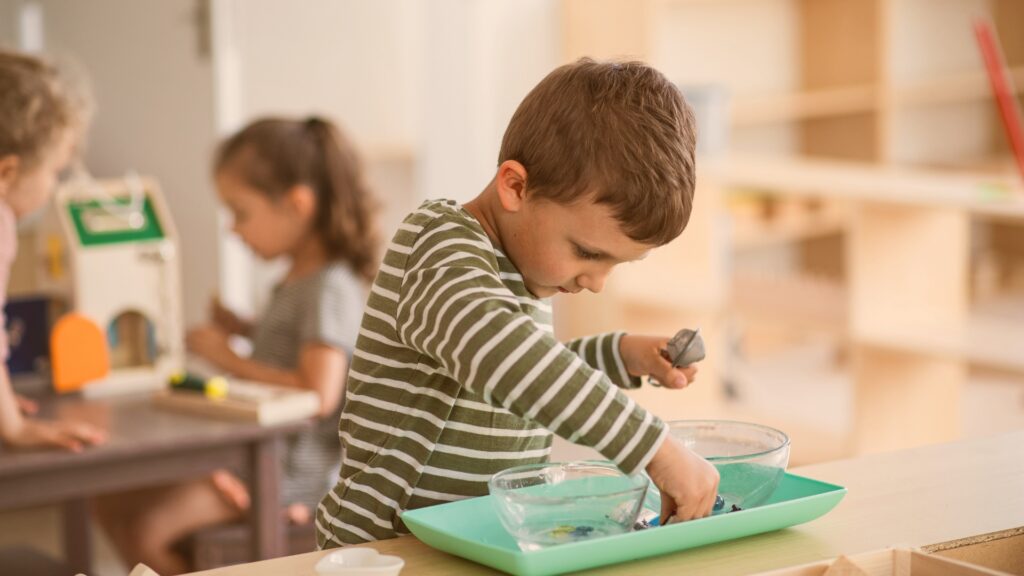
When a toddler pours their own milk and spills it, they aren’t rushed to the side while an adult cleans it up. Instead, they are shown where the sponge is and given the time to wipe up the spill themselves.
Every time a child struggles with a challenging zipper, a difficult math material, or a spilled tray—and successfully navigates it—they receive a powerful psychological message: “I can handle hard things.” This everyday mastery builds a reservoir of confidence that prevents them from crumbling when faced with larger emotional hurdles later in life.
3. Montessori Self-Regulation: The Freedom to Pause
Emotional resilience requires a high degree of self-regulation—the ability to monitor and manage your energy states, emotions, thoughts, and behaviors in ways that are acceptable and produce positive results.
The Montessori environment is a natural laboratory for self-regulation.
-
The Three-Hour Work Cycle: Uninterrupted blocks of time allow children to deeply immerse themselves in tasks. This deep focus (or flow state) is incredibly grounding and helps calm the nervous system.
-
The Peace Corner: Unlike a traditional “timeout” which acts as a punishment, a Montessori classroom often features a Peace Corner or a quiet space. Children are encouraged to visit this space voluntarily when they feel overwhelmed, angry, or tired. It is a place to restore internal balance, not a place of exile.
-
Movement with Purpose: Children are not forced to sit still at a desk for hours. If they feel restless, they can choose a work that involves walking, carrying heavy items, or scrubbing a table. This allows them to regulate their physical energy naturally.
4. Normalizing Mistakes as a Path to Growth
In a Montessori classroom, the materials themselves are designed with a built-in “control of error.” For example, if a child is placing cylinders into matching holes and ends up with one cylinder left over that doesn’t fit, the material itself shows them a mistake was made—no adult intervention required.
Because mistakes are depersonalized and treated merely as data, children lose the fear of being “wrong.” They learn to view a mistake not as a failure of their identity, but as a natural step in the learning process. When a child isn’t afraid to fail, they become infinitely more resilient when facing new, intimidating challenges.
Bringing Montessori Resilience Home
Building emotional resilience doesn’t stop at the classroom door. Parents can use these same principles to support their child’s social-emotional growth at home:
-
Step back and observe: When your child encounters a minor frustration (like a toy stuck under the couch), pause before intervening. Give them a few minutes to problem-solve on their own.
-
Validate the emotion, guide the behavior: Resilience doesn’t mean suppressing feelings. Acknowledge the frustration: “You are really angry that the tower fell over. It is okay to feel angry. It is not okay to throw the blocks. Let’s take a deep breath and see if we can rebuild the base.”
-
Provide an environment for independence: Make sure your home is set up so your child can help themselves. Low shelves for toys, a stool at the sink, and accessible snacks allow them to practice independence daily.
By prioritizing inner discipline, celebrating independence, and creating space for self-regulation, we help children build an emotional foundation that will serve them for the rest of their lives.