
In today’s highly connected world, managing children and devices is one of the most common hurdles modern parents face. Tablets, smartphones, and streaming apps are engineered to catch and hold attention, making them an incredibly easy fallback during a long car ride, a rainy afternoon, or while you are trying to cook dinner.
Yet, as parents explore the Montessori philosophy, they often notice a distinct absence of technology in early childhood classrooms. Authentic Montessori environments favor beautiful wooden blocks, real cloth, and natural landscapes over digital interactive apps.
Does this mean a Montessori home must be completely devoid of screens? Not necessarily. Navigating Montessori screen time is less about strict, guilt-inducing bans and more about establishing an intentional technology balance. By applying Dr. Montessori’s core observations about how the child’s brain develops, we can set healthy digital limits that protect their real-world growth.
1. The Concrete Brain vs. The Virtual Screen
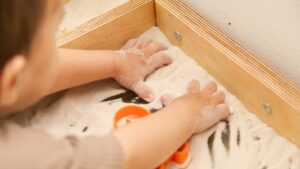
During the first six years of life, a child has what Dr. Montessori termed the “absorbent mind.” They construct their understanding of reality by interacting with the physical world using all five senses.
When a child plays with a physical wooden block, their brain gathers infinite data points: how heavy it is, how it balances, the texture of the grain, and the sound it makes when it falls. When a child swipes a digital block on a glass screen, their brain only receives two data points: a flat visual image and a smooth glass surface.
Because young children cannot yet fully separate 2D virtual representations from 3D physical reality, heavy device usage during these critical developmental windows can sometimes fragment their emerging focus. Our goal is to ensure the overwhelming majority of their day is spent touching, moving, and interacting with the concrete world.
2. Strive for “Real Life First”
The easiest way to find a healthy technology balance is to look at what screens might be actively replacing. A screen becomes a problem if it stands in the way of vital developmental activities.
Before introducing a device, ask yourself if your child has checked off their core developmental baseline for the day:
-
Gross Motor Movement: Have they run outside, climbed, jumped, and stretched their muscles?
-
Practical Life: Have they participated in real home tasks, like helping wash vegetables, setting the table, or putting away their toys?
-
Human Connection: Have they engaged in rich, back-and-forth verbal conversations with a caregiver or a peer?
If a child has spent their day moving, socializing, and exploring, a small, intentional block of screen time is far less likely to disrupt their baseline focus.
3. Move from Passive Consuming to Active Connecting
Not all digital media is created equal. When setting digital limits, consider the quality of the interaction rather than just the minutes on a timer:
-
Passive Consuming (Low Value): High-speed, chaotic cartoons featuring fast scene cuts and loud, flashing graphics. These overstimulate the nervous system, which frequently leads to behavioral meltdowns when the device is ultimately turned off.
-
Active Connecting & Reality-Based (High Value): Video calling a grandparent, watching a slow-paced documentary about animals they are interested in, or looking up a step-by-step woodworking tutorial.
Choose media that is grounded in reality, slow-paced, and serves as a launchpad for real-world exploration rather than a substitute for it.
4. Establishing Predictable Boundaries
To avoid daily power struggles, make your digital limits highly predictable and visually concrete.
Instead of saying, “You can watch a show for a little bit,” and then abruptly shutting it off—which causes intense frustration—anchor screen time to a natural transition in your daily routine. For example: “You may watch one episode after your room is tidied up on Saturday mornings.”
Use a physical sand timer or a visual clock so your child can physically see the time winding down. When boundaries are consistent, predictable, and clear, children naturally learn to accept them without negotiation.
Modeling Digital Boundaries
Ultimately, our children observe our relationships with devices far more than they listen to our rules. By consciously putting our own phones away during family mealtimes, morning greetings, and bedtime routines, we model what true presence looks like. We show them that while technology is a highly useful tool, the real, tangible world right in front of us is always the most exciting place to be.
At Casa Dei Bambini Montessori School, our state-of-the-art campuses feature spacious playgrounds, splash pads, and fully equipped physical classrooms built to satisfy your child’s natural urge for hands-on, real-world learning. Schedule a tour at our Riverstone or Telfair locations today to see our peaceful, screen-free environments in action!