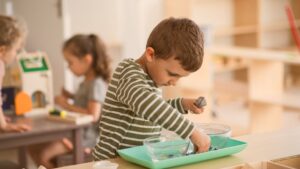
When parents first discover a Montessori classroom, they are often surprised to find young children spending hours washing tables, slicing bananas with dull knives, polishing silver, and buttoning frames. It is easy to wonder: With so much academic potential, why are they practicing everyday chores?
In the Montessori philosophy, these exercises are known as Practical Life activities. Far from being filler tasks or mere housekeeping, these real-world Montessori daily tasks are arguably the most vital component of the entire preschool environment. They are the essential foundation upon which all future academic success, focus, and emotional independence are built.
1. Building Gross and Fine Motor Skills
Young children have an innate, powerful urge to move their bodies and mimic the adults around them. Practical Life activities channel this energy into purposeful physical development.
-
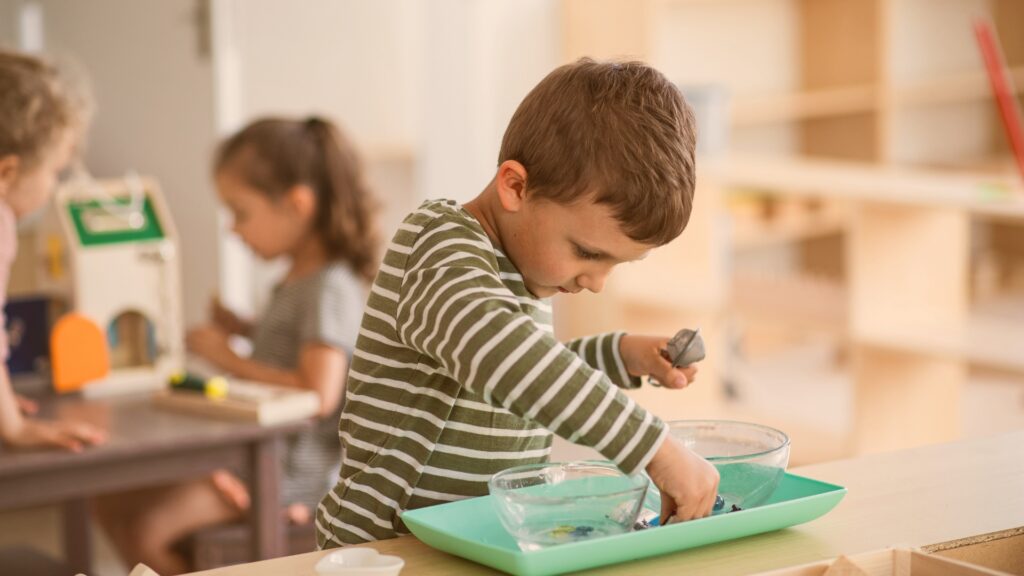
Fine Motor Skills: Actions like using tweezers to transfer pom-poms, using a tiny pitcher to pour water without spilling, or squeezing a sponge train the small muscles in the fingers and hands. This physical control and hand-eye coordination directly prepare the hand for writing.
-
Gross Motor Skills & Coordination: Carrying a heavy bucket of water across a busy room without spilling a drop, or scrubbing a large floor mat, requires core strength, balance, and intense spatial awareness.
2. Developing Executive Function and Concentration
An unexpected benefit of Practical Life is its profound impact on a preschooler’s cognitive development. Every single practical task requires a strict, logical sequence of steps.
Consider the task of washing a table:
-
Fetch the apron and put it on.
-
Carry the basin to the sink and fill it with water.
-
Bring the basin, soap, brush, and sponge to the table.
-
Apply soap, scrub in circular motions, wipe away the foam, and dry the surface.
-
Empty the dirty water, rinse the tools, hang the cloths to dry, and put everything away.
If a child skips a step, the sequence fails. By engaging in these multi-step processes, children naturally develop executive function, working memory, and an incredibly long span of deep concentration. This ability to focus intently on a task from start to finish is exactly what allows them to later tackle complex math and reading concepts.
3. Fostering True, Unshakeable Independence
There is nothing a preschooler loves to say more than, “I can do it myself!” The Practical Life curriculum honors this developmental milestone by giving children the actual skills needed to navigate their daily lives without constant adult assistance.
When a child learns how to button their own coat, wipe up their own spills, tie their shoes, and prepare their own afternoon snack, their self-image transforms. They stop viewing themselves as passive dependents who must constantly wait for an adult to help them. They realize they are capable, functional, and valuable contributors to their environment.
| Core Category of Practical Life | Example Classroom Activity | Developmental Benefit |
|---|---|---|
| Care of the Self | Buttoning, snapping, zipping frames; washing hands; blowing nose. | Personal autonomy, self-care habits, fine motor control. |
| Care of the Environment | Dusting shelves, watering plants, sweeping, polishing wood. | Respect for surroundings, social responsibility, gross motor control. |
| Control of Movement | Pouring liquids/grains, walking on the line, carrying a chair quietly. | Balance, spatial awareness, bodily self-regulation. |
| Grace and Courtesy | Greeting a guest, offering food, coughing into an elbow. | Social-emotional literacy, community care, manners. |
How to Bring Practical Life Into Your Home
You don’t need expensive classroom materials to bring Practical Life to life. In fact, your home is already the perfect laboratory for these tasks.
-
Slow down and allow time: The biggest obstacle to Practical Life at home is often adult haste. It takes a toddler much longer to put on their shoes than it takes you to do it for them. Whenever possible, bake extra time into your morning routine so your child can practice their skills without being rushed.
-
Provide child-sized tools: A standard-sized broom or a giant water pitcher is physically frustrating for a four-year-old. Invest in a functional, small-scale broom, a tiny apron, and a small glass pitcher that fits comfortably in their hands.
-
Embrace the mess: Spills are an essential part of the learning curve. If your child spills water while trying to pour their own drink, don’t get upset or rush to fix it. Calmly hand them a small towel and say, “The water spilled. Here is a cloth so you can wipe it up.”
By inviting your child to participate fully in the daily rhythms of home life, you aren’t just teaching them how to keep a clean space, you are building a confident, capable, and deeply independent individual.