In traditional schooling, children are strictly divided by birth year. A classroom of seven-year-olds learns alongside other seven-year-olds, working through identical material at a standardized pace.
But if you look at life outside the classroom, in families, neighborhoods, and the modern workplace, people thrive by collaborating across generations. Dr. Maria Montessori recognized this over a century ago, designing the mixed-age classroom as a pillar of her educational method.
At Casa Dei Bambini Montessori, our classrooms are grouped into multi-year developmental cycles: Toddler (15 months to 3 years), Primary (2.5 to 6 years), and Elementary. Far from being a logistical choice, this Montessori multi-age dynamic acts as a powerful engine for both social development and cognitive growth. Here is a look at how this unique environment benefits children at every stage.
1. The Power of Peer Learning (Cognitive Growth)
In a mixed-age setting, learning happens organically through a process known as peer learning.
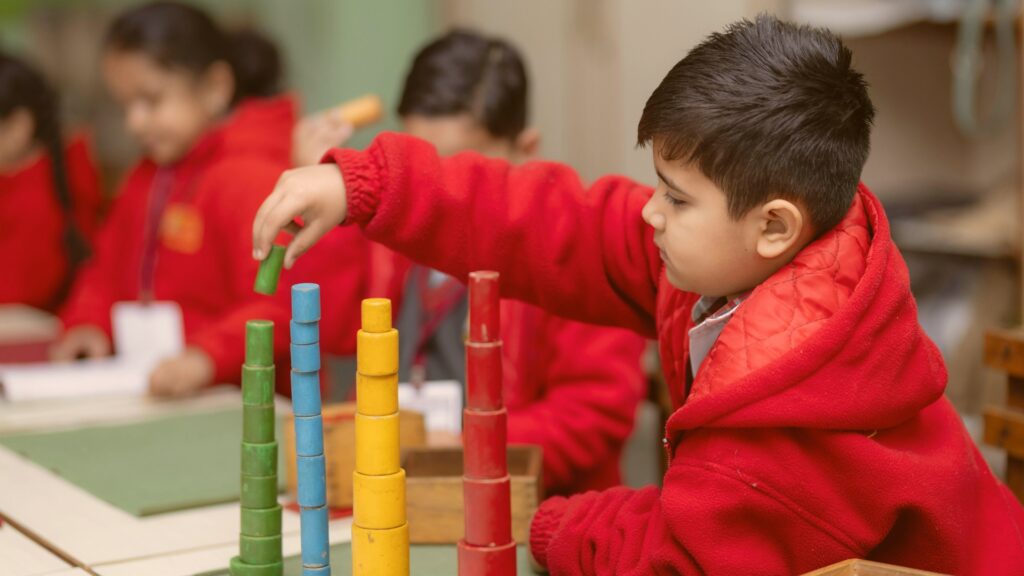
- For Younger Children: Younger students are constantly observing the older children in the room. They watch them handle complex math beads, read advanced books, and navigate tasks with focused concentration. This creates a natural curiosity and a vivid roadmap of what lies ahead. They aren’t just listening to a teacher explain an abstract concept; they see a peer doing it successfully right next to them.
- For Older Children: Reinforcement is the ultimate test of understanding. When an older child tutors or assists a younger classmate with a lesson, they are deeply consolidating their own cognitive knowledge. Explaining a concept requires clarity, patience, and a thorough mastery of the material.
2. Accelerating Social Development and Empathy
Growing up alongside peers of varying ages naturally mirrors a healthy family dynamic, cultivating profound emotional intelligence and social development.
Younger children feel safe knowing they can look to older classmates for guidance, comfort, or help with a tricky button. Meanwhile, older children step into leadership roles naturally. They learn to practice empathy, patience, and gentleness when working with smaller hands. This dynamic minimizes the competitive, comparative social pressures often found in single-age classrooms, replacing them with a culture of mentorship and mutual respect.
3. A Highly Individualized Learning Pace
In a single-age classroom, a child who falls behind can quickly feel discouraged, while a child who moves ahead might become bored. A multi-age classroom removes these rigid barriers.
Because the materials in a Montessori environment span a three-year developmental curriculum, a child can work comfortably at their own pace without judgment. A five-year-old who excels in math can easily reach for advanced materials typically used by six-year-olds. Simultaneously, if they need extra time to master reading, they can work with foundational materials alongside younger peers without feeling self-conscious. Every child’s learning arc is uniquely their own.
4. Continuity and Emotional Stability
When a child stays in the same classroom with the same teacher for three years, a deep bond of trust is formed.
Traditional students must adapt to a new classroom environment, new rules, and a new teaching style every autumn. In contrast, a Montessori student returns to a familiar space. Teachers already intimately understand the child’s learning habits, emotional triggers, and strengths from day one of the new school year. This sense of continuity provides immense emotional stability, allowing children to dive straight into deep, focused work without a lengthy transition period.
The Beautiful Rhythm of the Three-Year Cycle
Every child in a Montessori school gets to experience the complete cycle of growth. They start as the wide-eyed observer seeking help, transition into the confident, independent middle-performer, and graduate as the compassionate leader of the community. This rhythm doesn’t just build smart students, it builds confident, socially aware leaders ready for the real world.
Want to see a mixed-age classroom in action? At Casa Dei Bambini Montessori School, we invite families from our Missouri City, Sugar Land, Riverstone, and Telfair communities to see our vibrant classrooms first-hand. Schedule a private tour today to experience the Montessori difference!