
If you sit in the corner of a Montessori classroom for an hour, you will see the teacher do something unusual. They won’t always be moving around directing activities or talking. Instead, they will periodically sit back, entirely still, with a notebook in hand, quietly watching the children.
This isn’t passive downtime. In fact, child observation is considered the most critical responsibility of a Montessori guide. Dr. Maria Montessori was, first and foremost, a scientist and physician. She discovered her entire educational method not by theorizing, but by deeply, scientifically observing what children naturally do when given freedom in a supportive environment.
Through Montessori observation, educators can step out of the role of “director” and into the role of “decoder.” By adopting these same simple observation techniques at home, you can unlock a clearer understanding of your child’s behavior, defuse daily frustrations, and support their unique developmental needs. Here is how to practice the art of observation at home.
1. Separate the Facts from Your Feelings
When our children do things that frustrate us, like dumping out all the tissues from a box or repeatedly throwing their toys, our immediate emotional reaction is to label the behavior. We think, “They are being destructive,” or “They are trying to push my buttons.”
Montessori observation asks us to strip away our interpretations and focus entirely on the objective, physical facts.
Instead of thinking: “My toddler is making a huge, ungrateful mess with their water cup.”
Observe the facts: “My child has filled and poured water back and forth between their cup and plate six times, watching the splash each time.”
When you look strictly at the facts, you realize the behavior isn’t an act of defiance. It is a biological urge to experiment with gravity, volume, and cause-and-effect.
2. Identify the Hidden “Sensitive Period”
Dr. Montessori identified specific windows of time in early childhood called sensitive periods. During these phases, a child’s brain is intensely, almost single-mindedly driven to master a specific skill—such as order, small objects, movement, or language.
When a child exhibits a repetitive, frustrating behavior, it is almost always a sign of an unmet developmental need linked to a sensitive period. Your job as an observing parent is to figure out what that hidden need is, so you can redirect it to a safe outlet:
| Observed Behavior | The Underlying Sensitive Period | How to Support It Safely |
| Pulling all the books off the shelf | Spatial awareness & Maximum Effort | Give them heavy items to carry, like a basket of small pumpkins or canned goods. |
| Picking up tiny specks of dirt or bugs | Refinement of the senses (Small Objects) | Offer a tray with tweezers and large beads, or a sorting activity with beans. |
| Constantly climbing on the dining table | Gross motor coordination | Create an indoor obstacle course with cushions, or maximize playground time. |
3. Step Back Before Stepping In (The 10-Second Rule)
When we see a child struggling with a task, like trying to fit a puzzle piece together or putting a shoe on the wrong foot, our parental instinct is to leap across the room and fix it for them.
The next time you see your child hit a roadblock, try implementing the Montessori 10-Second Rule. Pause, take a deep breath, and quietly count to ten while watching their hands.
Often, you will notice that if given those few extra seconds of uninterrupted mental space, the child will adjust their strategy, rotate the puzzle piece, and solve the problem entirely on their own. Stepping in too early robs them of the immense rush of confidence that comes from triumphing over a challenge. If they truly need help, offer the absolute minimum assistance required to get them past the hurdle, rather than taking over the work.
4. Notice What Brings Them Joy and Focus
Observation isn’t just for troubleshooting problem behaviors; it’s also for discovering what truly lights your child up.
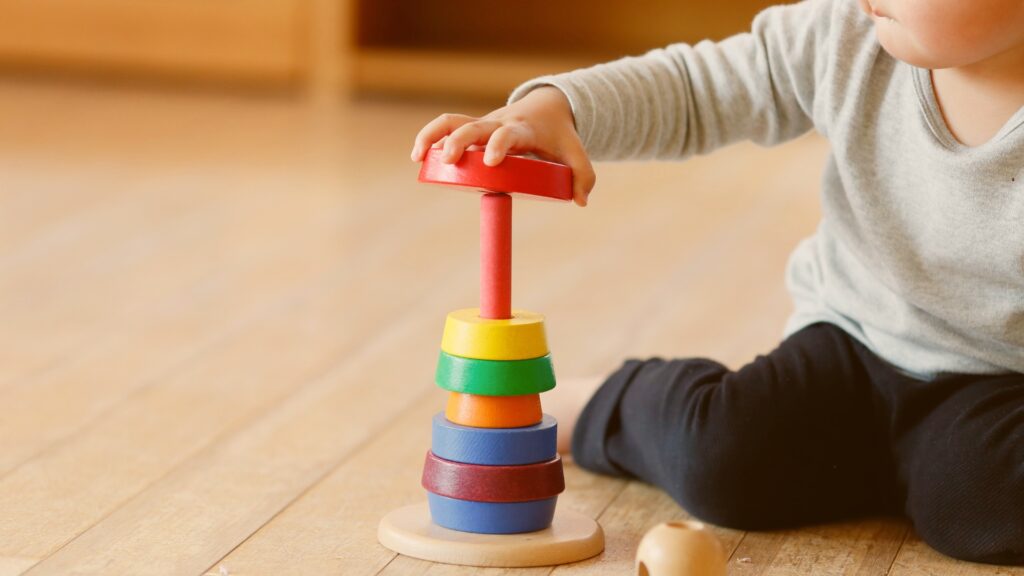
Watch for moments of deep, quiet focus. What activity makes them completely tune out the rest of the room? Is it matching matching colors? Is it pouring liquids? Is it sorting shapes? When you spot these pockets of deep concentration, you have found exactly where their brain is growing the fastest. Honor that moment by protecting it from interruptions—even well-meaning praise like “Good job!” can break their deep psychological focus.
Seeing Your Child with Fresh Eyes
By shifting your role from a parent who constantly manages behavior to a scientist who observes it, your home dynamic will shift dramatically. You’ll stop seeing “problems” and start seeing beautiful, natural milestones unfolding right in front of you.
At Casa Dei Bambini Montessori School, observation is the foundation of our individual learning plans. Our certified educators track every child’s sensitive periods to introduce math, language, and practical life works at the perfect psychological moment. Schedule a tour at our Riverstone or Telfair locations today to learn how we personalize your child’s education!