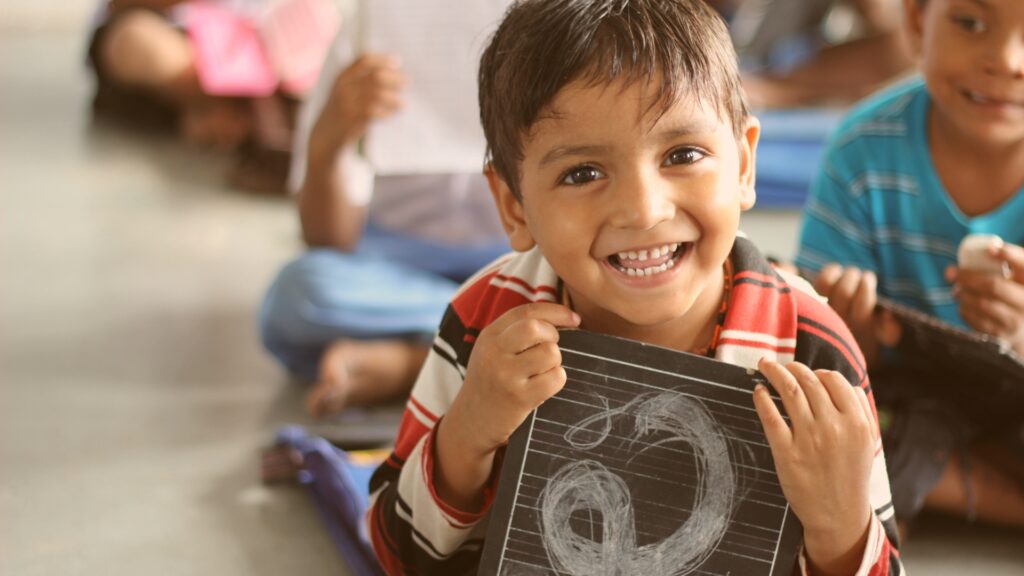
When a child turns six, a dramatic psychological transformation occurs. The cozy, orderly world of the Primary environment—where the focus was on sensory exploration, individual mastery, and personal independence, suddenly feels too small. The child enters what Maria Montessori called the “Second Plane of Development.”
The 6-year-old transition marks the entry into Montessori elementary (Lower Elementary covers ages 6–9; upper elementary Montessori covers ages 9–12). If the preschooler asks “What is this?”, the elementary child asks “Why?” and “How?”
Here is what families can expect as their child steps into this expansive, deeply collaborative phase of education.
1. The Gateway to Everything: The Cosmic Curriculum
At the heart of the Montessori elementary experience is Cosmic Education. This is not a standard, siloed curriculum divided into isolated subjects like reading at 9:00 AM and math at 10:00 AM. Instead, it is an integrated web of knowledge designed to answer the elementary child’s burning curiosity about the universe.
The curriculum kicks off every single year with The Five Great Lessons. These are impressionistic, dramatic storytelling experiences utilizing science experiments, timelines, and impressionistic charts:
-
The Coming of the Universe and the Earth (Physics and Chemistry)
-
The Coming of Life (Biology and Botany)
-
The Coming of Human Beings (History and Anthropology)
-
The Story of Writing (Language and Literacy)
-
The Story of Numbers (Mathematics and Geometry)
These grand stories give the child a holistic blueprint of history. From there, individual student research ignites. A study of early humans naturally spirals into creative writing, geography, botanical timelines, and mathematical calculations of distance.
2. From Individual Order to the “Herd Instinct”
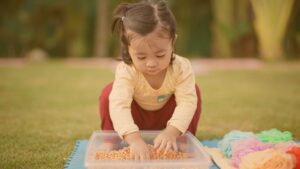
If you visit a Primary classroom, you will see children working mostly individually or in pairs, fiercely protective of their own workspaces. If you visit an Elementary classroom, it looks completely different. It is loud, busy, and highly social.
Maria Montessori noted that 6- to 12-year-olds have a strong “herd instinct.” They want to do everything together. The elementary curriculum leverages this natural social formatting rather than fighting it. Almost all work is collaborative. Children form small committees to research projects, create massive timelines, or solve complex geometric equations together.
Through this constant collaboration, they learn the high-level social-emotional skills of negotiation, project management, division of labor, and collective accountability.
3. Going Out: Expanding Beyond the Classroom Walls
Because the elementary child is developing a fierce interest in society, justice, and how communities function, their learning cannot be contained inside a single room.
In Montessori elementary, field trips are replaced by student-led initiatives called “Going Outs.”
When a small group of children needs data for a project, for instance, researching local bird species, they don’t just look it up online. They take ownership of the entire process:
-
They find a local expert or library.
-
They draft the email or make the phone call to schedule a visit.
-
They calculate the transportation costs or map out the public transit route.
-
They arrange for adult chaperones.
This builds an unshakeable sense of capability and agency. The world becomes their classroom.
The Changing Role of the Parent
As your child moves into the elementary years, your parenting style will naturally shift from managing physical care to supporting moral and intellectual exploration. Elementary children are deeply preoccupied with fairness and rule-making. They will question authority and stress-test boundaries.
Support this growth by allowing them to experience the natural consequences of their organizational choices. If they forget to plan ahead for a group project, let them navigate that tension with their peers. Your role is no longer to clear the path for them, but to act as a steady sounding board as they figure out their place in the wider universe