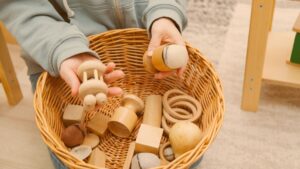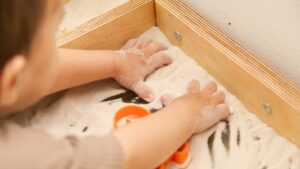
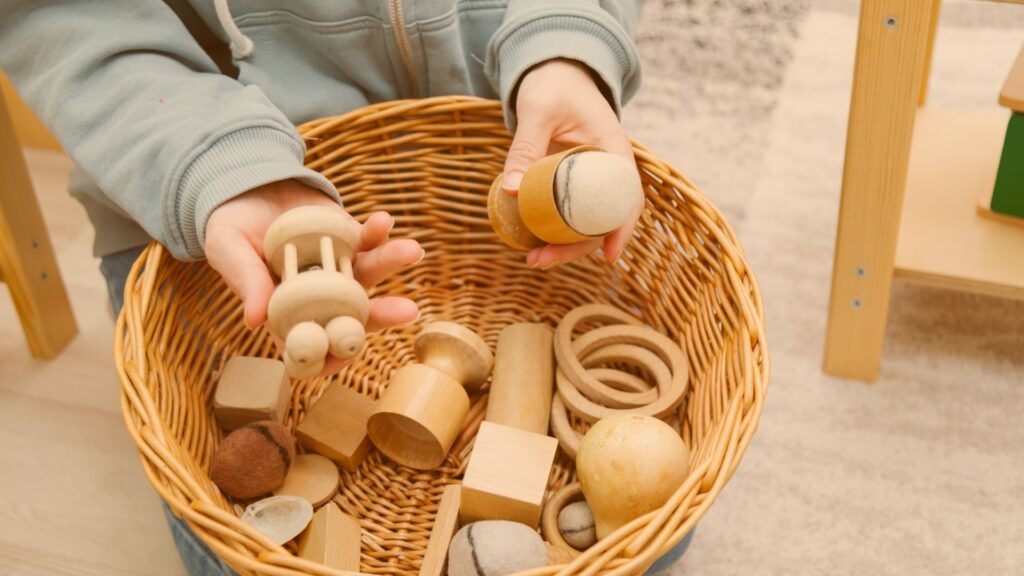
Walk into any Montessori Primary classroom and you’ll notice a shelf of strikingly simple wooden objects: a tower of pink cubes stacked largest to smallest, a set of cylinders that fit snugly into matching holes, small wooden blocks that ring with different tones when tapped. To an unfamiliar eye, these can look more like art pieces or toys than academic materials. Parents often ask, understandably: what exactly is my child learning by stacking blocks?
The answer is one of the most elegant parts of the entire Montessori method — these materials are called the sensorialmaterials, and they’re designed to do something remarkably specific: help a young child’s brain organize and make sense of the sea of sensory information it’s constantly taking in.
The Problem Sensorial Materials Solve
From birth, a child’s senses are bombarded with input — colors, sounds, textures, weights, smells, shapes — far more than any brain could consciously process all at once. Maria Montessori observed that young children have an extraordinary, almost effortless capacity to absorb this information (what she called the “absorbent mind”), but that this raw sensory data needs to be sorted, categorized, and refined in order to become useful, transferable knowledge.
Sensorial materials do exactly that: each one isolates a single sensory quality — like size, weight, texture, sound, or color — and presents it in a graded, precise way that lets the child’s brain build a clear, organized mental framework for that quality. Rather than learning “big” and “small” abstractly through a worksheet, the child feels the difference, physically manipulating objects that vary in only that one respect.
A Few Materials, Decoded
The Pink Tower. Ten pink wooden cubes, ranging from 1 cubic centimeter to 1,000 cubic centimeters, meant to be stacked largest to smallest. This isn’t just an exercise in tidy stacking — it’s teaching the child to visually and physically discriminate differences in three-dimensional size, building an intuitive sense of scale and proportion that later supports both math and spatial reasoning.
The Knobbed Cylinders. Wooden blocks with cylinders of varying height and diameter that fit into matching holes. As the child works through the set, they’re refining visual discrimination of size and developing the fine motor precision (via the small knob grip) that will later support pencil control for writing.
The Color Tablets. Pairs and gradations of colored tablets used for matching and grading by shade. This builds visual discrimination of color — a skill so refined in later stages that children work with subtle gradations most adults would struggle to sequence correctly.
The Sound Cylinders. Sealed cylinders filled with different materials that produce different sounds when shaken, used for matching pairs by sound alone. This isolates and trains auditory discrimination — an underrated skill that later supports phonemic awareness for reading.
The Rough and Smooth Boards / Fabric Box. Materials for exploring tactile discrimination — different textures to touch, compare, and eventually describe in words like “rough,” “smooth,” “coarse,” or “soft.”
Why Isolating One Quality at a Time Matters
The genius of these materials lies in what Montessori called the “isolation of quality” — each material varies in only one dimension while holding everything else constant. The Pink Tower cubes are all the same color and material; only size changes. The Color Tablets are all identical in size and shape; only color changes.
This matters enormously for how children learn. If a material varied in multiple ways at once — size, color, and texture together — a child would have a much harder time isolating exactly what concept they’re meant to be discriminating. By controlling every variable except one, these materials let the brain build a crystal-clear category for that single quality, uncluttered by irrelevant differences.
From Concrete Senses to Abstract Thought
Perhaps the most important — and least obvious — function of sensorial work is that it lays the groundwork for abstract thinking later on. A child who has spent hundreds of hours physically grading objects by size, weight, and shade has built a deep, embodied understanding of concepts like “larger than,” “in order of,” and “matches with.” These aren’t just vocabulary words to them — they’re lived, physical experiences.
That embodied understanding becomes the scaffolding for later academic work. Grading cylinders by size supports the same underlying logic later needed for ordering numbers. Matching sound cylinders by pitch builds the same discrimination skills used in phonemic awareness for reading. The sensorial materials, in other words, aren’t a cute pre-academic detour — they’re the actual foundation that later academic learning is built on top of.
Why the Materials Are Self-Correcting
Nearly every sensorial material includes a built-in “control of error” — a way for the child to see for themselves whether they’ve completed the work correctly, without needing an adult to check or correct them. Cylinders that don’t fit into their matching holes, a tower that visibly wobbles if stacked out of order — these give immediate, judgment-free feedback.
This is a deliberate design choice. It allows children to work independently, to make mistakes without fear of external correction, and to develop genuine internal confidence in their own perception and judgment — rather than relying on an adult to tell them whether they got it “right.”
What This Looks Like at Home
You don’t need authentic Montessori materials to support sensorial development at home:
- Offer sorting and grading opportunities with everyday objects — nesting cups, matching socks by size, arranging spoons from smallest to largest.
- Play sound-matching games with household items — film canisters or small containers filled with rice, beans, or bells.
- Name sensory qualities explicitly as you encounter them together: “This blanket is soft, that towel is rough.”
- Resist the urge to correct immediately. Let your child notice their own mismatches when possible — it builds the same independent confidence the classroom materials are designed to foster.
The next time you see your child at a shelf of simple wooden blocks, know that far more is happening than meets the eye. Those quiet, repetitive movements are quite literally building the sensory and cognitive architecture your child will use for the rest of their academic life.