When most of us picture “school,” we picture desks, worksheets, and walls. Outdoor time, in that traditional model, is usually filed under “recess” — a pressure valve, a chance to burn off energy before returning to the real work indoors. But in a Montessori environment, that division doesn’t really exist. The outdoors isn’t a break from learning. It’s an extension of the prepared environment itself.
What “Prepared Environment” Really Means
Montessori classrooms are famous for being carefully arranged, child-sized furniture, materials organized by subject and displayed at a child’s eye level, everything with a clear place and purpose. This is what Maria Montessori called the “prepared environment”: a space intentionally designed to support independence, concentration, and discovery.
What’s less well known is that Montessori herself considered nature an essential part of that prepared environment, not an optional add-on. She wrote extensively about the importance of connecting children to the natural world, believing that direct contact with living things, plants, animals, soil, weather, offered a kind of sensory and conceptual richness that no indoor material could fully replicate.
In other words: a garden bed is just as much a piece of Montessori “curriculum” as a set of sandpaper letters.
Practical Life, Outside
Many of the same practical life skills children practice indoors, pouring, scooping, carrying, sequencing a task from start to finish — translate directly outdoors, often with even higher stakes and higher motivation. Watering a real plant that will wilt if forgotten carries a different weight than a pretend indoor task. Raking leaves, digging, planting seeds, and harvesting vegetables all build the same fine and gross motor coordination, sequencing skills, and sense of purposeful work that indoor practical life exercises are designed to teach — but with the added richness of real seasonal change and consequence.
There’s also a strong care-taking component. Tending a garden bed over weeks or months teaches patience and delayed gratification in a way that’s difficult to replicate with any classroom material. A child who plants a seed in September and harvests a vegetable in November has experienced a concrete, memorable lesson in cause, effect, and time that no worksheet could deliver.
Sensorial Learning, Amplified
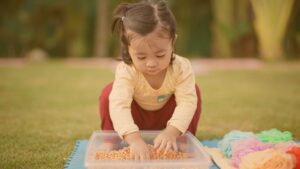
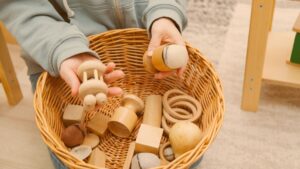
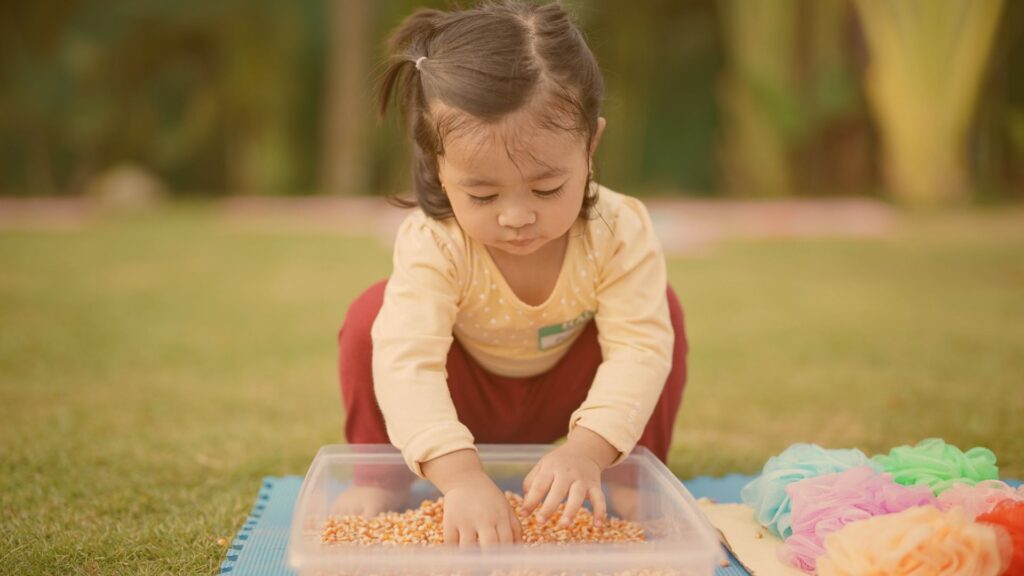
Montessori’s sensorial materials exist to isolate and refine a child’s perception of qualities like color, texture, weight, and sound. Nature offers all of these in far greater complexity and nuance than any classroom material can. The gradation of colors in autumn leaves, the different textures of bark and stone, the sounds of birds and wind, the weight of a stone compared to a similarly sized piece of wood — all of it sharpens the same sensorial discrimination skills that materials like the color tablets or sound cylinders are designed to build indoors.
Outdoor time also supports what Montessori called the “absorbent mind”, a young child’s extraordinary capacity to take in enormous amounts of information from their environment simply by being immersed in it. A walk through a garden, paying attention to insects, changing leaves, or weather patterns, feeds that absorbent mind just as effectively as a classroom lesson.
Concentration and Freedom of Movement
One of the more counterintuitive Montessori observations is that unstructured outdoor time doesn’t undermine a child’s ability to concentrate, it supports it. Children who have ample opportunity for large-muscle movement and fresh air tend to return indoors more able to settle into focused, quiet work, not less. Movement and concentration aren’t in competition; in the Montessori view, they’re partners.
This is part of why many Montessori classrooms build outdoor time into the regular rhythm of the day rather than treating it as an occasional reward, and why outdoor materials and work areas are often set up with the same intentionality as an indoor shelf.
Bringing This Home
You don’t need a large yard or a formal garden to apply this philosophy at home:
- Give your child real outdoor jobs, not just outdoor play. Watering a plant, sweeping a porch, or collecting fallen leaves for compost all count as legitimate, purposeful work.
- Resist over-scheduling outdoor time. Unstructured exploration, poking at dirt, watching bugs, arranging rocks — builds concentration just as much as a planned nature activity.
- Let the seasons show up in your home life. Bringing in a few branches, seed pods, or leaves to observe up close extends outdoor learning indoors.
- Try a small container garden, even just a few pots on a balcony, if a yard isn’t available. The scale matters less than the ongoing responsibility.
- Narrate what you notice together — the texture of bark, the sound of wind, the color of the sky before rain — modeling the kind of careful, sensorial attention Montessori classrooms cultivate.
In a Montessori environment, stepping outside was never meant to be a pause from real learning. It’s simply the classroom continuing to unfold, just with dirt under the fingernails.