If you have more than one child at home, you already know that sibling relationships can swing between tender and turbulent within the same afternoon. Squabbles over toys, comparisons of who did better at what, and the classic “that’s not fair” refrain are practically rites of passage in family life. But what if the way we structure our environments actually shapes how much of that rivalry occurs in the first place?
In a Montessori classroom, cooperation between children of different ages isn’t a happy accident, it’s built into the design. And understanding why it works so well in the classroom can give parents real, practical tools for reducing competition and building genuine cooperation at home.
Why Montessori Classrooms Don’t Have “Grades”
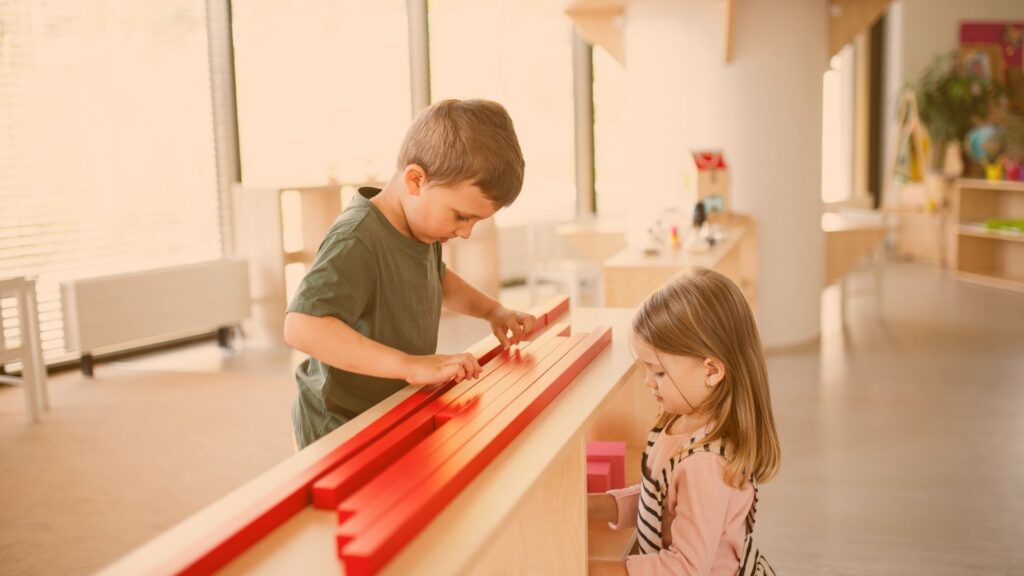
One of the first things visitors notice about a Montessori environment is that children of different ages work side by side in the same room. A Primary classroom, for example, might include three-, four-, and five-year-olds all pursuing their own individual work at the same time.
This is intentional. Dr. Maria Montessori observed that when children are grouped strictly by age and asked to master the same material at the same pace, comparison becomes almost unavoidable. Someone is always “ahead” and someone is always “behind,” and children absorb that hierarchy quickly, even when adults never say a word about it.
In a mixed-age Montessori community, there’s no single benchmark everyone is compared against. A five-year-old isn’t “better” than a three-year-old at reading; they’re simply further along their own individual path. This subtle shift removes a huge amount of the fuel that competition runs on.
The Power of the Older Child as Mentor
Perhaps the most important dynamic in a mixed-age classroom is the natural mentorship that develops. Older children are frequently asked to demonstrate a lesson to a younger classmate, help a peer who is struggling, or simply model calm, careful work.
This role does something remarkable for the older child: it transforms their more advanced skill from a source of status into a source of purpose. Instead of using their ability to feel superior, they learn to use it to serve someone else. Teaching a concept to another child also reinforces the older child’s own understanding, a well-documented cognitive benefit.
For the younger child, having a peer mentor (rather than only an adult authority figure) makes new skills feel more attainable. Watching someone just a little bit older successfully pour water or button a frame is far more encouraging than watching an adult who has clearly had decades of practice.
Applying This at Home
You don’t need a full Montessori classroom to bring these principles into your household. Here are a few ways to shift the sibling dynamic at home:
Give the older child real responsibilities, not just favors. Instead of “can you watch your sister for a minute,” try “would you show your sister how we set the table” or “can you help your brother find his shoes.” Framing it as a genuine contribution — rather than free babysitting, builds a sense of purpose rather than resentment.
Avoid direct comparisons entirely. Phrases like “your brother could do this at your age” or “why can’t you sit still like your sister” plant seeds of resentment on both sides. Instead, speak to each child’s own progress: “You’re getting so much better at tying your shoes” rather than measuring against a sibling.
Create work that isn’t a competition. Cooking together, gardening, or a shared practical-life task (like folding laundry or preparing snack) gives siblings a shared goal rather than a shared scoreboard. When there’s no “winner,” children are far more likely to collaborate.
Let the younger child struggle a little before an older sibling swoops in. Just as guides in the classroom wait to see if a child can work through a challenge before offering help, encourage older siblings to observe rather than immediately “fix” things for younger ones. This respects both children’s independence.
Protect individual work time. Just as each child in a Montessori classroom has protected, uninterrupted time with their own materials, try to build in moments where each child at home has your full attention or their own space to work without a sibling’s involvement. Cooperation flourishes more easily when children don’t feel they’re constantly competing for the same limited resources — including your attention.
A Shift in Perspective, Not a Quick Fix
Sibling rivalry will likely never disappear entirely, it’s a normal part of family life, and a certain amount of friction is simply part of how children learn to negotiate relationships. But by borrowing the Montessori classroom’s approach to mixed-age community, removing unnecessary comparison, creating opportunities for genuine mentorship, and giving each child their own sense of purpose, families can shift the overall tone of sibling relationships from rivalry toward real cooperation.
The goal isn’t a household with zero conflict. It’s a household where siblings increasingly see each other as teammates rather than competitors, a shift that tends to pay dividends well beyond childhood.